
5 Types Of Corporate Videos Your Company Needs
Most companies don’t need more video. They need the right five.
We get calls that start with “we should probably be doing video” and end, forty minutes later, with a much more useful sentence: we have a conference in April, nobody outside the building knows what we actually do, and it takes six weeks to get a new hire up to speed. Those are three different problems, and they need three different videos.
Here are the five that most companies end up making, what each one is actually for, and what to know before you commission one.
1. The brand film
What it’s for: answering “who are you and why should I care” in ninety seconds, for someone who has never heard of you.
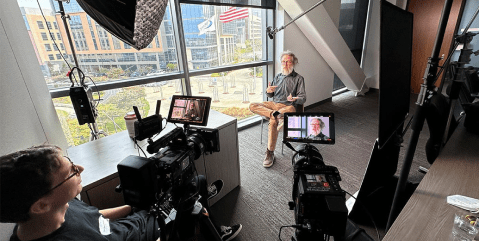
This is the one that goes at the top of your homepage, gets opened before a sales meeting, and plays on the screen behind your booth. It isn’t a list of services. It’s the reason your company exists, told through the people who do the work — which is why the best ones are built around interviews with your own team rather than a script read by a narrator.
Before you commission one: decide who it’s for. A brand film aimed at customers and a brand film aimed at recruits are two different films, and trying to make one do both produces something that does neither. Pick.
2. Event and conference video
What it’s for: turning a room you already paid for into twelve months of content.
You’re already spending money on the booth, the flights and the keynote slot. A crew on site turns that into a recap film for next year’s sponsors, interview footage with customers who are all in one place for once, session recordings for people who couldn’t attend, and enough short vertical cuts to keep social fed until the next one.
Before you commission one: book the crew before you book the room, or at least before the run-of-show is locked. The difference between good event footage and a series of compromises is almost entirely about access — where the crew can stand, whether there’s a clean audio feed off the board, and whether anyone told the AV team you were coming.
3. Training video
What it’s for: teaching the same thing the same way, without pulling your best person off the floor to do it.
Onboarding, safety, equipment, process. The economics here are the clearest of any video on this list: you’re comparing the cost of making it once against the cost of a senior employee explaining it in person every time somebody new starts. In a company hiring steadily, that maths stops being close very quickly.
Before you commission one: write the outline before you call anyone. Training video lives or dies on structure, and the structure has to come from you — you know the ten things a new hire gets wrong. We can shape it, shoot it and cut it, but we can’t invent your process.
4. Testimonial video
What it’s for: letting a customer say the thing you can’t credibly say about yourself.
Nobody believes a company that calls itself responsive. They believe a customer who describes the Sunday somebody actually showed up. That’s the whole mechanism, and it’s why the useful part of a testimonial is almost never the compliment — it’s the specific story around it.
Before you commission one: pick people, not logos. The instinct is to chase your biggest client, but your biggest client will route it through legal and hand you a sentence of approved language. A mid-sized customer who genuinely likes working with you and speaks like a human being will out-perform them every time.
5. Product demo video
What it’s for: showing how something works to someone deciding whether it solves their problem.
Sales teams send these constantly, which makes them the most-used video most companies own and often the least-considered. The failure mode is always the same: a feature tour that starts with the interface instead of the problem, made by people who already know what everything does.
Before you commission one: watch someone unfamiliar try to use the thing, and note where they hesitate. That’s your script. The demo should answer questions in the order a real buyer asks them, which is rarely the order in which the product was built.
Which of the five do you actually need?
Start with the problem, not the format.
- Nobody knows who we are → brand film
- We have an event coming up → event coverage, booked early
- Onboarding is eating our senior people → training
- Our sales calls stall on trust → testimonials
- Prospects don’t understand the product → demo
Most companies work through two or three of these over a couple of years, and the smart ones plan the shoots together even when the videos ship separately. A crew that’s already on site for a training shoot can pick up testimonial interviews and brand-film B-roll in the same day, which is most of the reason a bundled two-day shoot costs so much less than three separate one-day ones.
If you’re weighing this up, the useful next step isn’t a quote — it’s a conversation about which of the five you need first.
Request a free quote or call us and we’ll talk it through.
Notes from the field
 August 2024
Why Corporate Needs Videos
Corporate video production has become an essential tool for businesses in Denver and throughout the USA looking to enhance their marketing efforts,…
Read it →
 April 2024
Advertising Agencies
Advertising agencies play a pivotal role in helping businesses develop and execute effective marketing campaigns to reach their target audience and achieve…
Read it →
 April 2024
What is Commercial Video Production
One of the most common questions we get is what is commercial video production and what it entails? Commercial production is a…
Read it →
Free quote, no obligation · We respond within one business day